
Delivery & Risk
Reversible or Not: The Only Question That Should Set Your Decision Speed
Zarar Ismail · 20 August 2026 · 6 min read
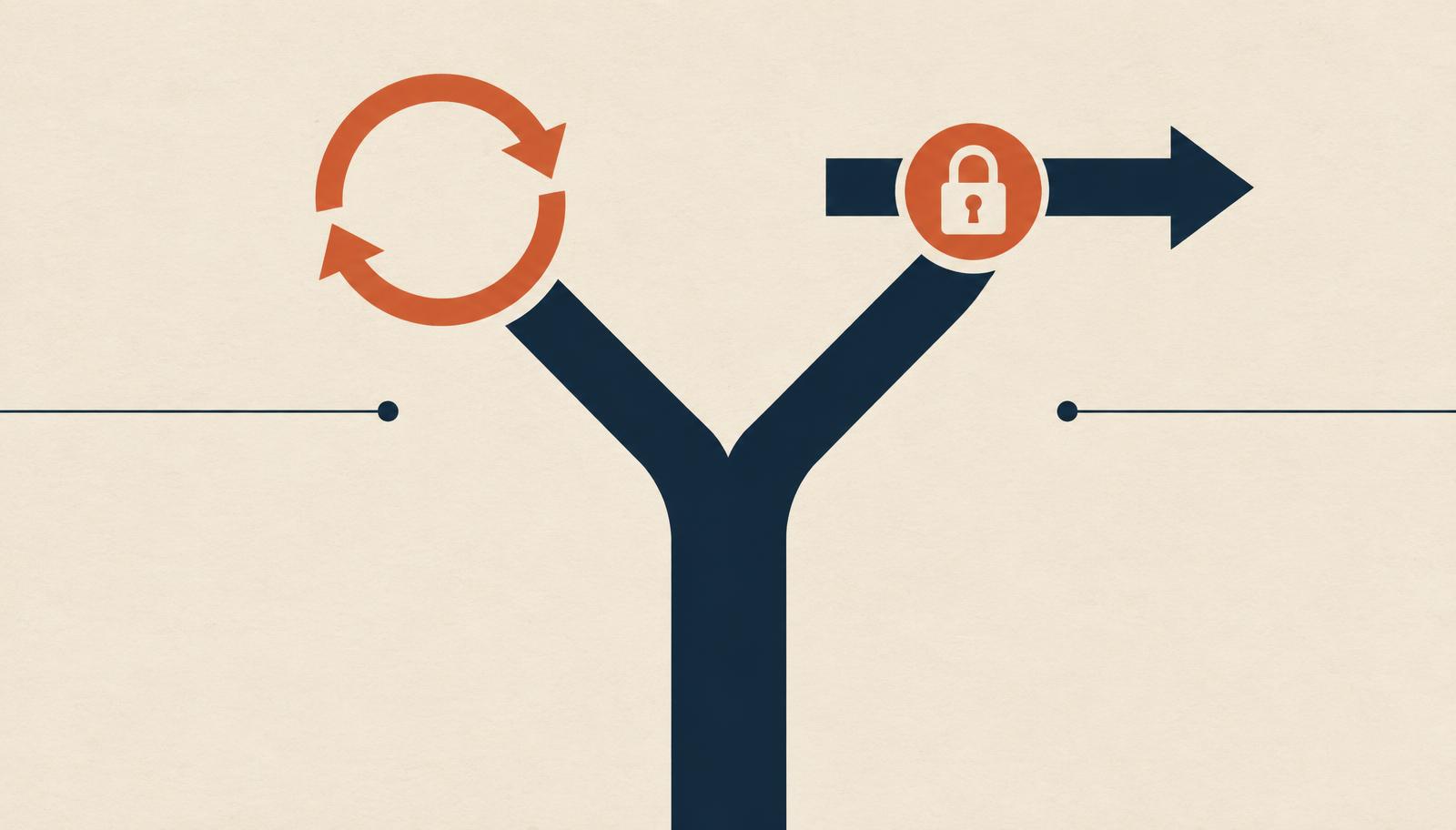
Most of the decisions your team is currently agonising over do not deserve a meeting, let alone the three they're going to get. And at least one of the decisions someone made last Tuesday in a corridor is going to be haunting you in 2029.
The problem isn't that people decide too slowly or too fast. It's that they run everything at the same speed.
The question is not "how big", it's "how expensive to walk back"
Teams sort decisions by size. Big spend, big meeting. Small spend, quick call. It feels sensible and it's almost useless, because cost has very little to do with how hard something is to undo.
A quarter of a million pounds of cloud spend is reversible. You turn it off. It hurts, someone has an awkward conversation with finance, and in six weeks it's a line in a report. A naming convention for your account structure costs nothing and you will still be living with it when your grandchildren are in the industry, because by the time it's wrong there are four hundred things named after it.
So sort by reversal cost instead. For every decision on the table, ask one question: if this turns out to be wrong in six months, what does it cost us to change our minds? Then let the answer set the speed.
Cheap to reverse: decide today, decide alone if you're the accountable person, tell people afterwards. Deciding fast is not recklessness when the downside is a fortnight of rework. The rework is cheaper than the delay and much cheaper than the meeting.
Expensive to reverse: slow down deliberately, write the case down, get the people who'll be stuck with it in the room, and make the choice explicitly rather than letting it happen. Most irreversible decisions in technology aren't made. They're drifted into by a team that was moving fast because moving fast had become the culture.
What actually locks a decision in
Reversal cost comes from a small number of places, and once you can name them you can spot the heavy decisions before they land on you.
Data gravity. Anything that accumulates records gets harder to move every single day it runs. Your choice of primary datastore is effectively permanent about four months after go-live, whatever the migration guide claims. The decision was reversible on the Tuesday you made it and not on the Friday six months later.
Contracts and money already spent. A three-year licence with a minimum commitment is an irreversible decision wearing a procurement costume. So is anything with a termination clause you haven't read. If someone in your organisation signs it, you own it, regardless of who negotiated it.
People and habit. Change the deployment pipeline and you're changing what 60 engineers do with their hands every day. Six months in, the tool is the least of it. The runbooks, the on-call muscle memory and the two people who became the internal experts are the real switching cost, and none of that appears on the comparison spreadsheet.
Public commitment. The moment a date or a capability is said out loud to a customer or a board, reversing it costs credibility rather than money, which is a currency you can't top up quickly.
Notice what's missing from that list: how much the thing costs to buy. Purchase price tells you almost nothing about reversibility, and it's the number everyone anchors on.
The refresh where we got this exactly backwards
A logistics company, 60 depots, a network and compute refresh running over about fourteen months. Two decisions landed in the same week.
The first was the monitoring and alerting stack. It generated a six-week evaluation, a scoring matrix with weighted criteria, three vendor demos and two workshops with the operations team. The steering group discussed it twice.
The second was the IP addressing scheme for the new depot builds. An engineer picked it on a Thursday afternoon because the first site build needed to start on the Monday. Perfectly competent engineer, perfectly reasonable scheme, nobody reviewed it, and it took about twenty minutes.
Now look at the reversal costs. Swapping the monitoring stack eighteen months later would have been genuinely annoying: rebuilding dashboards, redoing alert routing, retraining the operations team. Call it a painful quarter for a small group of people, and entirely survivable.
The addressing scheme allocated each depot a block that assumed no depot would ever need more than a certain number of devices. Three years on, the larger distribution sites blew through it when the warehouse automation arrived, and fixing it meant renumbering live sites, touching every firewall rule that referenced those ranges, and coordinating outages with a business that runs 24 hours a day. That work is still going on. It will outlast several of the people who started it.
We spent six weeks on the reversible one and twenty minutes on the permanent one, and everyone involved, including me, thought we were being rigorous. We were being rigorous about the thing with a price tag, because a price tag is what triggers governance in most organisations.
The fix wasn't a better process. It was one question asked out loud in the design review: which of these can we undo next year, and what would it cost? Nobody asked it.
The two ways this goes wrong
Treating a reversible decision as permanent is the common failure and the more forgivable one. It's slow, it's tiring, it burns your team's patience, but it rarely breaks anything outright. You lose weeks.
Treating a permanent decision as reversible is the one that ends up in a post-incident review three years later. And it's harder to spot, because at the moment it happens it looks like exactly the behaviour your organisation has been asking for. Fast. Decisive. Unblocking the team. The engineer who picked that addressing scheme on a Thursday afternoon did nothing wrong. The leadership around her failed to notice which kind of decision it was, and that includes me.
If you want one habit out of this, it's that you personally check the reversal cost of anything that's about to be decided quickly. Speed is the right default. It just needs a hand on the brake in the four or five places a year where it matters.
Before your next design review
Take whatever list of open decisions your team is carrying, and add one column: what it costs to reverse this in six months. Fill it in with a sentence, not a rating. "Rebuild the dashboards, two weeks, ops team annoyed" is useful. "Medium" is not.
Then take the top item, the one that's most expensive to walk back, and give it a named owner and a date this month. That's the one that gets the slow conversation. Everything below it gets decided in the room, by the person accountable, on the day it comes up.
Zarar Ismail
Founder of the Institute of Technical Leadership, writing from two decades of technical delivery.