
Career
Engineers Aspiring to Become Technical Leaders: Why Technical Skills Alone Are No Longer Enough
Principal Architect · 8 November 2026 · 8 min read
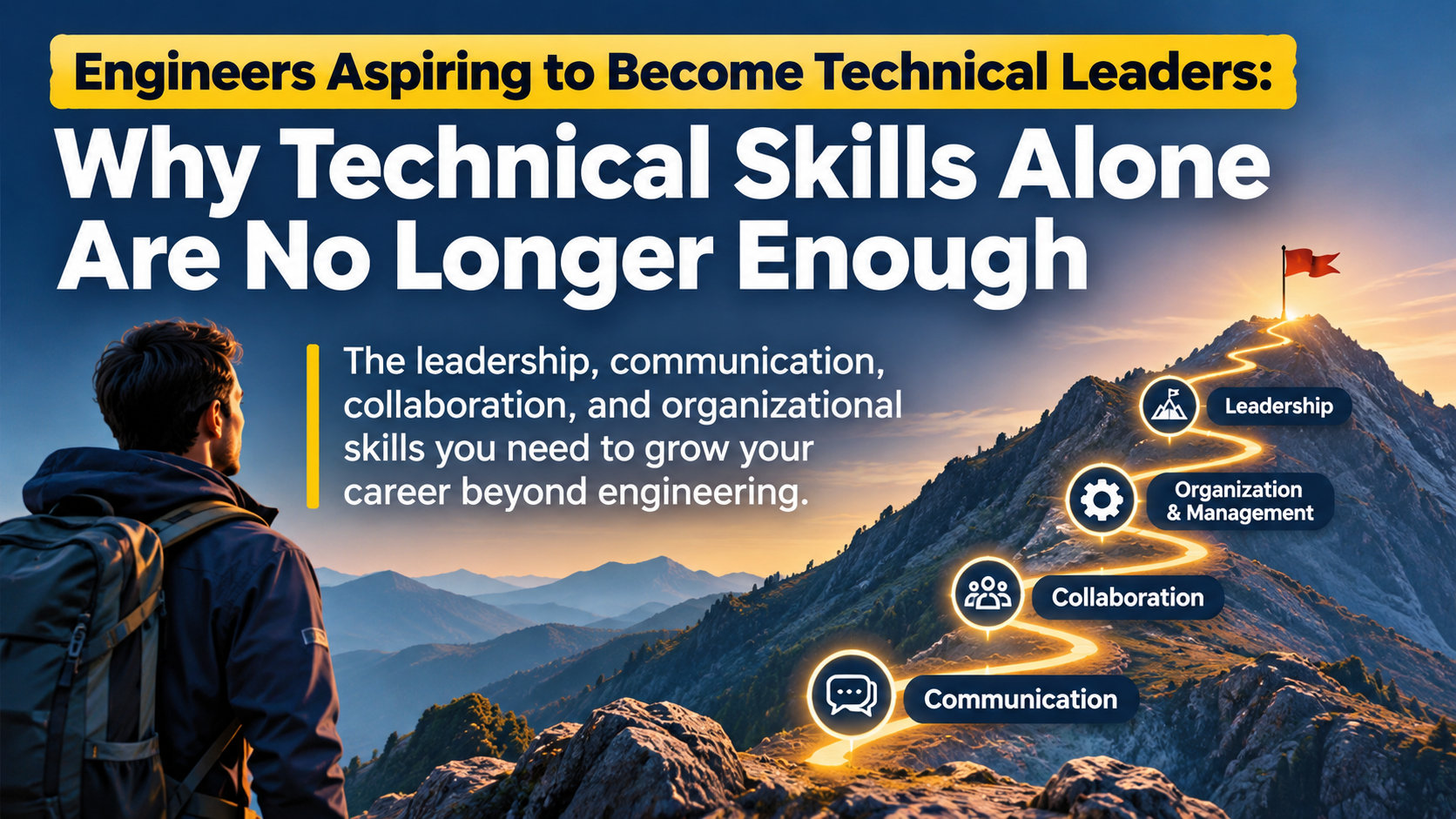
If you want to progress from engineer to technical leader, developing communication, collaboration, stakeholder management, and leadership skills is just as important as deepening your technical expertise.
The Skills That Made You a Great Engineer May Not Be Enough to Make You a Great Technical Leader
Most engineers spend the early years of their careers developing technical expertise. They invest countless hours learning technologies, earning certifications, troubleshooting complex problems, designing solutions, and becoming the person others turn to when something goes wrong.
And rightly so. Technical competence is the foundation of a successful engineering career.
But there comes a point when being the best technical person in the room is no longer enough to progress.
The skills that help you become a great engineer are not necessarily the same skills that will help you become a great technical leader.
This is an important distinction that many engineers discover only when they begin pursuing senior technical roles.
What GitLab's Engineering Leadership Framework Teaches Us
GitLab provides an interesting perspective on this transition in its publicly available Engineering IC Leadership framework.
The framework explains that moving from a Senior Engineer to a Staff Engineer represents a significant change in responsibilities and expectations.
Importantly, this transition does not necessarily mean moving into people management. Engineers can continue progressing as individual contributors while taking on increasingly significant technical leadership responsibilities.
However, the skills required to succeed begin to change. GitLab identifies three capabilities that become increasingly important alongside technical expertise:
Communication. Collaboration. Leadership.
The underlying message is powerful: as engineers progress, their impact must extend beyond the technical work they personally deliver.
They must increasingly help others succeed, influence technical direction, remove obstacles, and contribute to decisions that affect the wider organization.
GitLab describes this concept as technical leverage: creating an impact that extends beyond an individual's own work. For aspiring technical leaders, this is a fundamental shift in mindset.
From Solving Technical Problems to Influencing Outcomes
Consider two engineers working on a major network modernization project.
Both have excellent technical knowledge. Both understand the architecture, technologies, security requirements, and operational challenges.
The first engineer concentrates on designing the best possible technical solution. They produce a comprehensive architecture, select the appropriate technologies, and present their recommendations.
The second engineer does all of that, but also takes time to understand the priorities of the cybersecurity team, operational concerns of the infrastructure team, financial constraints of management, and expectations of the business.
They engage stakeholders early, explain technical trade-offs in business terms, address concerns, and build agreement around the proposed solution.
Both engineers demonstrate technical competence. But the second demonstrates something more: the ability to lead a technical initiative across organizational boundaries.
This is what separates technical expertise from technical leadership.
In large organizations, especially those operating complex infrastructure, the best technical solution is not always the one that gets implemented. Successful implementation often depends on whether people understand the solution, trust the recommendations, agree on the priorities, and are willing to support the necessary changes.
The Non-Technical Skills Every Aspiring Technical Leader Must Develop
Technical leadership requires a broader set of capabilities than technical execution alone.
1. Communication: Making Complex Ideas Understandable
A technical leader must communicate effectively with different audiences.
An engineer may need to explain a network architecture to another engineer, describe security risks to a business executive, or justify an infrastructure investment to a finance team. Each audience has different priorities and levels of technical understanding.
The ability to translate technical complexity into clear business implications is therefore essential.
Technical knowledge creates value. Effective communication helps others recognize and act on that value.
2. Stakeholder Management: Building Trust and Alignment
One of the most overlooked skills in engineering career development is stakeholder management.
As engineers become more senior, their work increasingly involves people outside their immediate technical teams. These may include business leaders, project managers, cybersecurity teams, operations, finance, vendors, and customers. Each stakeholder brings different objectives, concerns, and expectations.
A technical leader must understand these perspectives, manage competing priorities, and build the relationships necessary to move initiatives forward.
This is not about office politics or pleasing everyone. It is about creating alignment so that technically sound decisions can become successful organizational outcomes.
The ability to influence people without having formal authority over them is one of the defining characteristics of technical leadership.
3. Collaboration: Delivering Results Through Others
Early in their careers, engineers are often recognized for what they can accomplish individually. As they progress, their contribution is increasingly measured by the impact they enable across teams.
This requires sharing knowledge, mentoring colleagues, working across technical disciplines, and helping others solve difficult problems.
GitLab's framework reinforces this principle by emphasizing that senior individual contributors create greater value when their work improves the effectiveness of others.
The objective is no longer simply to be the person who can solve the hardest problem. It is to help build an organization that can solve difficult problems more effectively.
4. Organization and Management: Turning Ideas into Execution
Technical leaders also need to understand how work gets organized and delivered.
This includes planning, prioritization, resource coordination, risk management, decision-making, and managing dependencies. A brilliant architecture has limited value if the organization cannot implement it successfully.
For example, leading a data center transformation requires more than understanding compute, storage, and networking. It also requires coordinating multiple teams, managing operational risks, sequencing activities, resolving dependencies, and maintaining alignment with business objectives.
These organizational capabilities become increasingly important as the scope and complexity of technical responsibilities grow.
5. Leadership: Creating Impact Beyond Your Own Work
Perhaps the biggest transition is learning to lead without relying on a management title.
Technical leaders do not necessarily have direct reports. Their influence comes from credibility, sound judgment, communication, trust, and the ability to bring people together around a common direction.
They help teams navigate uncertainty, make difficult decisions, develop technical capabilities, and understand why particular approaches matter.
Their success is reflected not only in the quality of their own work, but also in the effectiveness of the people and teams around them.
You Don't Have to Become a Manager to Become a Leader
One particularly valuable aspect of GitLab's framework is its recognition that technical leadership and people management are different career paths.
Engineers can progress into Staff, Principal, and other senior technical roles without abandoning their technical specialization. GitLab describes several patterns of senior technical leadership, including Tech Lead, Architect, Solver, and Right Hand roles.
These roles differ in their responsibilities, but share a common characteristic: their impact extends beyond individual technical execution.
This is an important message for engineers who love technology and want to remain close to it.
You do not have to stop being technical to become a leader. But you do have to develop capabilities beyond technology.
Start Developing These Skills Before You Need Them
One mistake engineers can make is waiting until they receive a leadership title before developing leadership capabilities. In reality, these skills are best developed long before the promotion.
Start by volunteering to present technical recommendations to non-technical audiences. Take responsibility for coordinating a small cross-functional initiative. Build relationships with stakeholders outside your immediate team. Mentor less-experienced engineers. Learn how technical decisions connect to financial, operational, and business outcomes.
And perhaps most importantly, pay attention to how experienced technical leaders navigate disagreements, influence decisions, and build organizational trust.
These experiences develop the capabilities needed for broader technical responsibility.
Final Thoughts: Your Next Career Breakthrough May Not Be Technical
Engineering careers often begin with a simple formula: learn more, solve harder problems, and become technically stronger.
That formula remains valuable, but it becomes incomplete as responsibilities grow. The transition from engineer to technical leader requires a shift from individual technical contribution toward broader organizational influence.
Technical expertise remains essential. It provides the credibility and judgment that effective technical leadership depends upon. But communication, collaboration, stakeholder management, organization, and leadership determine how effectively that expertise can be applied across an organization.
If you aspire to become a Technical Lead, Staff Engineer, Principal Engineer, or Technical Architect, ask yourself:
Am I investing as much effort in developing my ability to lead and influence people as I am in developing my technical knowledge?
Because your next career breakthrough may not come from mastering another technology.
It may come from learning how to bring people together to achieve something that technical expertise alone cannot deliver.
Further Reading
GitLab — Engineering IC Leadership
Read GitLab's Engineering Leadership Framework
This article draws on GitLab's publicly documented approach to senior individual contributor leadership, particularly its emphasis on technical leverage, communication, collaboration, and leadership beyond the Senior Engineer level.
Principal Architect
Founder of the Institute of Technical Leadership, writing from two decades of technical delivery.