
Leading People
Beyond Code: Google’s Research on Effective Technical Leadership
Principal Architect · 21 October 2026 · 5 min read
Introduction
The transition from engineer to technical leader involves a fundamental change in the nature of professional contribution. Technical proficiency remains important, but leadership effectiveness also depends on the capacity to develop others, establish direction and enable collective performance. Google’s research on managers provides a useful empirical perspective on this transition.
This article summarises Following the data: The research behind great managers, published by Google re:Work in August 2025 and authored by Sarah Calderon and Debbie Newhouse. It considers the findings of Projects Oxygen and Aristotle, their application within Google, and their implications for technical leadership.
Project Oxygen: Management as a Set of Observable Behaviours
Google’s investigation began with a provocative proposition: managers might contribute little value, or even impede innovation. Project Oxygen challenged that assumption by analysing more than 10,000 data points from performance reviews and feedback surveys, supplemented by extensive interview material.
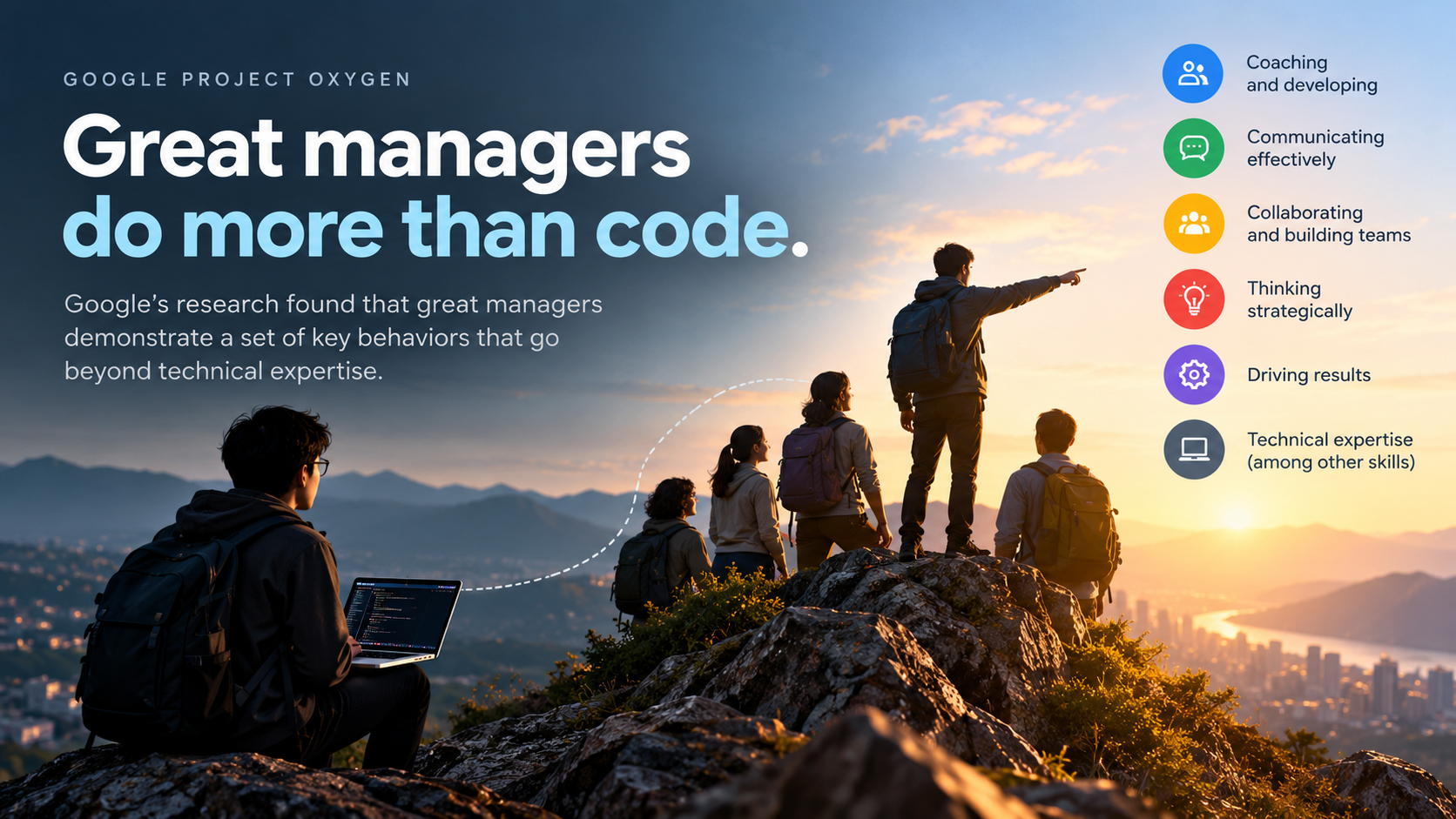
According to the article, teams with highly effective managers were more likely to achieve stronger results, report greater happiness and experience lower turnover. Google identifies ten behaviours associated with effective management:
- Providing effective coaching.
- Empowering employees without micromanaging.
- Creating an environment in which everyone is valued.
- Maintaining a focus on productivity and results.
- Communicating effectively.
- Supporting career development and discussing performance.
- Establishing a clear vision and strategy.
- Possessing relevant technical skills.
- Collaborating across organisational boundaries.
- Making strong decisions.
The significance of this framework lies in its behavioural emphasis. Management is presented not simply as a consequence of seniority or technical distinction, but as a collection of practices that can inform development and evaluation. Technical expertise is one element within this broader set, rather than a substitute for it.
Project Aristotle: The Importance of Team Processes
Project Aristotle extended the investigation from individual managers to the dynamics of effective teams. Google studied hundreds of teams internationally, examining outcomes such as product-launch success and achievement of revenue goals.
The article’s central conclusion is that how people work together matters more than who is on the team. Meaningful and clear goals, open communication and continuous learning are presented as important features of effective collaboration.
Google reports that teams exhibiting these characteristics were rated as effective twice as often by their managers. In the sales context, effectively collaborating teams exceeded revenue targets by an average of 17%, while less effective teams fell short by up to 19%. These figures describe findings reported within Google; they should not be interpreted as performance improvements that every organisation can expect to reproduce.
For technical teams, the implication is that assembling capable specialists is insufficient on its own. Leadership must also attend to the conditions under which expertise becomes coordinated action.
Translating Research into Manager Responsibilities
Google incorporated these findings, alongside further research and employee feedback, into three core manager responsibilities:
- Deliver Results: determine priorities, communicate goals and sustain motivation and adaptability during change.
- Develop People: clarify expectations, provide coaching and feedback, and support career growth.
- Build Community: strengthen collaboration, connection and open communication to support sustainable performance.
The framework informs Google’s performance reviews, feedback processes and leadership development. The article also reports that employees whose managers perform strongly against these responsibilities describe higher productivity, a stronger sense of purpose and more opportunities for learning.
Implications and Limitations for Technical Leaders
Taken together, these findings support a broader conception of technical leadership. A leader’s contribution includes enabling sound decisions, helping colleagues develop and establishing shared direction, rather than remaining the principal solver of every technical problem. This is an interpretation of the research for engineering practice, not a separate finding demonstrated by the source article.
The evidence also requires contextual caution. The article is an organisational research summary, not a complete methodological report. It does not provide sufficient detail to independently evaluate sampling, statistical controls or causal identification. Associations between management practices and team outcomes therefore should not automatically be read as proof of causation, nor assumed to generalise unchanged beyond Google.
Finally, the article suggests that AI can assist managers with planning, coaching preparation and relationship-building activities. Such use should respect organisational policies and avoid exposing confidential information or personal data to public AI tools.
Conclusion
Google’s account positions effective management as a combination of results-oriented practice, people development and collaborative team processes. For engineers progressing into leadership, its principal lesson is that technical capability must be complemented by deliberate investment in the behaviours that enable others to succeed.
Reference and Further Reading
Calderon, S., & Newhouse, D. (2025, August). Following the data: The research behind great managers. Google re:Work.
Read the full Google re:Work article.
This is an independent summary and commentary by the Institute of Technical Leadership, not a Google publication or endorsement. The cover image is an accompanying illustration, not a research figure from the source article.
Principal Architect
Founder of the Institute of Technical Leadership, writing from two decades of technical delivery.